
We make decisions all day. Some are tiny: Should I reply now or later?
Some have consequences:
– Should we launch this now?
– Should we invest in this technology?
– Should we change the way our team works?
Then, there are the decisions where everyone seems to have an opinion, the data is incomplete, and nobody is quite sure what happens next.
That last category is becoming increasingly common.
In 2026, leaders are making decisions in an environment shaped by AI, shifting customer expectations, changing markets, distributed teams and information that can change faster than the plan built around it.
When we’re faced with a difficult decision, our instinct is often to gather more information. But more information doesn’t always make the answer clearer. Sometimes, we first need to understand what we are actually dealing with.
A framework worth knowing: Cynefin
Developed by Dave Snowden, a researcher and management consultant, the Cynefin Framework is designed to help decision-makers understand the nature of a situation before deciding how to respond.
It broadly places situations into five contexts:
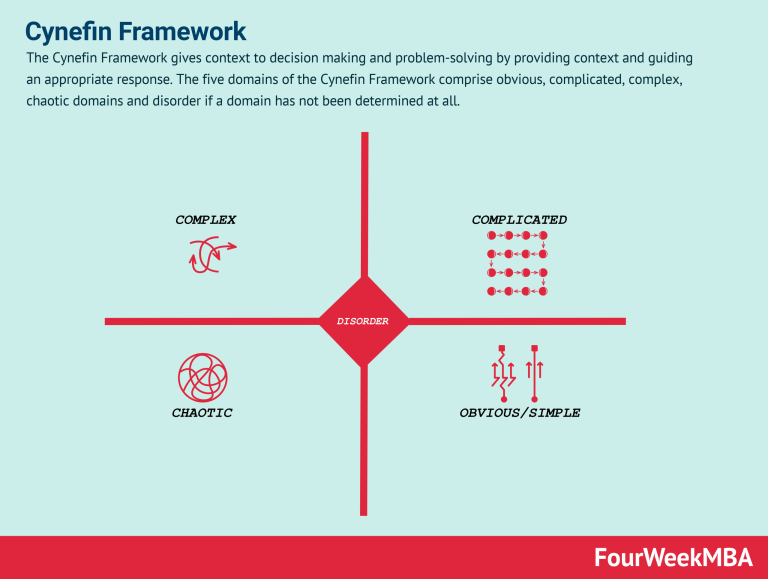
1. Clear: The answer is known
- Cause and effect are obvious. There is an established process, and following it makes sense.
- Think: “This happens every month. We know what to do.”
2. Complicated: The answer needs expertise
- The problem can be understood, but it may take analysis or specialist knowledge to find the right answer.
- Think: “We have several options. Let’s look at the data and get the right people involved.”
3. Complex: The answer emerges as you experiment
- This is where things get interesting. The relationship between cause and effect isn’t obvious in advance. You may need to try something, observe what happens and adapt.
- Think: “We’re introducing AI into this workflow. We don’t yet know what will work best.”
4. Chaotic: Act first, understand later
- The situation is unstable. Waiting for perfect information can make things worse. The immediate priority is to stabilise the situation, then work out what comes next.
- Think: “Something has gone seriously wrong. We need to respond now.”
5. Disorder: We don’t know which situation we’re in
- And this may be the most familiar one. Everyone is looking at the same problem differently.
- One person wants more data. Another wants to act immediately.
Someone else says, “We’ve always done it this way.” - Before choosing an answer, you first need to understand the nature of the problem.
Why does this matter in 2026?
Think about it: you wouldn’t spend three hours discussing a routine issue. And a tricky people problem probably won’t be solved by looking at a spreadsheet.
Sometimes, we’re not making the wrong decision; we’re just approaching it the wrong way. That’s where Cynefin can help. It encourages us to pause and ask: “What kind of situation are we actually dealing with?”
Because we won’t always have complete information when a decision needs to be made.
“What matters is knowing how to move forward, learn from what happens, and adapt. Good decision-making is as much about responding to what we discover along the way as it is about making the initial choice.”
– Sharmila Gautama, Founder, EnglishCoach Services
In 2026, knowing how to navigate uncertainty may be just as important as knowing how to make the decision itself.